Engineering & Functional safety assurance
- Functional safety support and assurance
- Verification / Validation / Qualification
- Test and evidence planning
Functional safety and cybersecurity: from development to operation – tailored to your application.
Safe · Modular · Secure by Design
Background imageAI-generated concept visualisation
System understanding, engineering and evidence for industry and rail.
Development · Assurance · Standards
Application areas
A safety function extends from detecting a condition to delivering an effective response. We consider this complete chain together with hardware, software and interfaces. System design with ETENAR Safe Config and engineering with ETENAR Safe Kit remain aligned with the same requirements.
Describe hazards, safety functions and operating conditions. The required risk reduction and applicable framework determine the requirements for the function.
Assign functions to building blocks and define interfaces and fault responses. Clear module boundaries make dependencies visible and support subsequent changes.
Check that the implementation meets its requirements and the safety function is suitable for the application. Keep test cases, results and deviations traceably linked.
Include maintenance, testing and new system versions. Assess changes and their effects on unchanged parts, and determine which existing evidence remains applicable.
One shared system baseline: requirements, configuration, software and test results provide the basis for integration and further development.
Plan modernisationProtection for deployment, operation, updates and servicing.
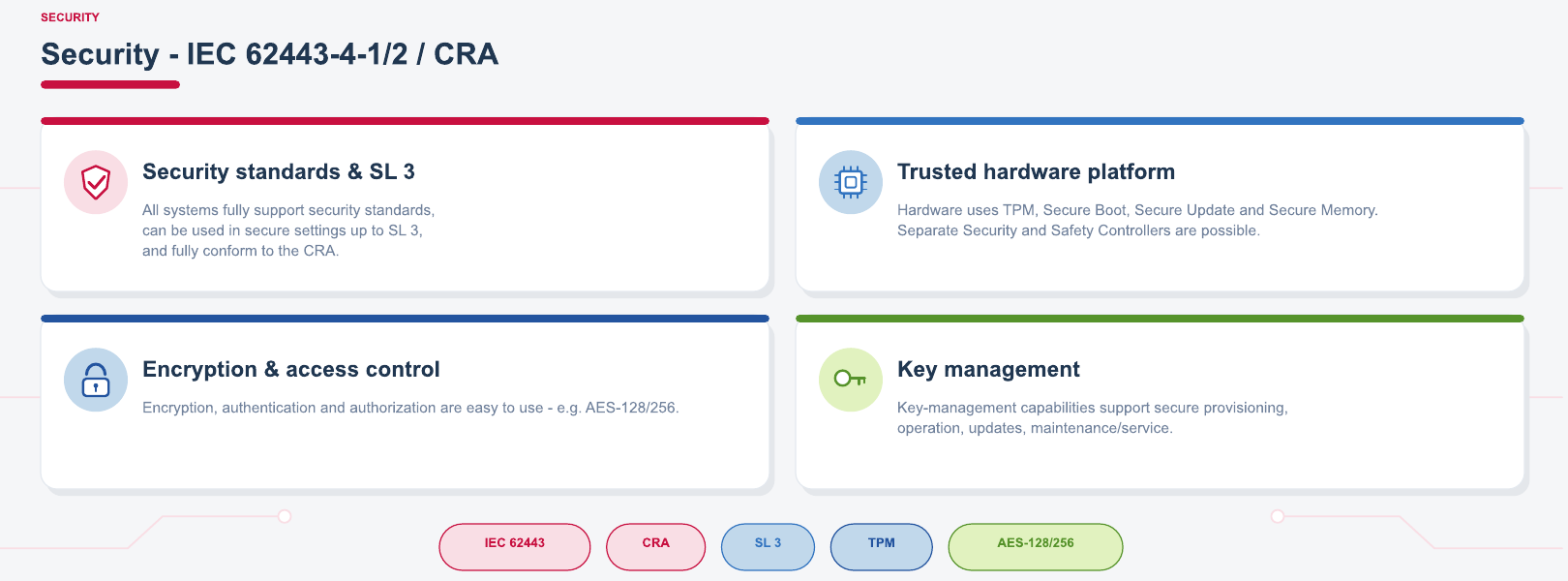
IEC 62443: development process (4-1), components (4-2), systems (3-3). Applicable CRA requirements are considered in the product and development process.
Selected configurations may include TPM-backed trust, Secure Boot, secure updates and protected storage.
Authentication, authorisation and encryption are defined in the security concept. The selected variant determines the mechanisms and interfaces available.
Key management functions can support provisioning, operation, updates and servicing throughout the system lifecycle.
Protection mechanisms need suitable operating conditions and clear responsibilities. Manufacturers, integrators and operators therefore agree how access, keys, updates and vulnerabilities will be managed throughout the system's working life.
Describe available protection mechanisms, product versions and operating conditions. Secure provisioning, software maintenance and information for integration form part of the development task.
Define: the product baseline, security functions and maintenance procedures.
Align communication paths, system boundaries and access rights with the environment. The security concept also considers interfaces between components and interactions with safety functions.
Define: interfaces, permissions and integration tests.
Assign responsibilities for maintenance, updates and vulnerability handling. Assess and test changes before adoption, then document them in the released system baseline.
Define: contacts, approvals and change procedures.
The IEC 62443 series distinguishes development processes, components and systems. Required measures and evidence depend on the specific role, product variant and application.
SIL 1–4 describes the safety integrity of a safety function under IEC 61508. The required level follows from the risk assessment and the applicable framework.
The standard, product version, system boundaries and operating conditions define the scope of evidence. Product evidence does not replace system validation. Security Levels are not equivalent to SIL; earlier editions of standards may apply to existing projects.
Product certificates and their scope are provided for the project where available for the selected configuration.
We start with the application and clarify the scope of evidence required.